Research themes
- Electronic structure study of actinide compounds and related materials by synchrotron radiation X-ray spectroscopy.
- Electronic and chemical state analysis for Fukushima environmental recovery and decommissioning research by synchrotron radiation X-ray spectroscopy.
- Development and improvement of measurement techniques and experimental environments for photoelectron spectroscopy and X-ray spectroscopy under high magnetic fields.
- Maintenance and management of the experimental equipment for X-ray spectroscopy installed in the JAEA contract beamline at SPring-8.
- Support for users of the JAEA beamlines at SPring-8.
Group Leader
YAMAGAMI Hiroshi

Manager
FUJIMORI Shinichi
Overview
The Electronic Structure Research Group studies the electronic and magnetic states of strongly correlated electron systems such as actinide compounds by synchrotron radiation X-ray spectroscopy in order to elucidate the mechanism of their novel physical properties. We are also developing and upgrading synchrotron radiation spectroscopic techniques and experimental equipment, and using them to support Fukushima environmental recovery and decommissioning. The synchrotron radiation from the JAEA beamlines, SPring-8 BL22XU and BL23SU, where our group is conducting research, is also available at the RI laboratory where radioactive materials can be handled. It is the world's most advanced research facility for synchrotron radiation X-ray spectroscopy.
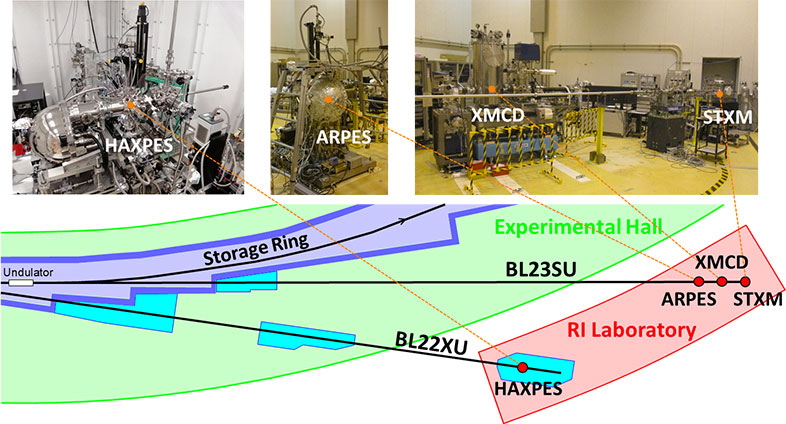
The soft X-ray beamline BL23SU is equipped with soft X-ray angle-resolved photoemission spectrometer (ARPES), a soft X-ray absorption magnetic circular dichroism spectrometer (XMCD), and a scanning transmission X-ray microscope (STXM). ARPES is an experimental technique that can experimentally derive the energy band structure and Fermi surfaces of solids. In particular, by using soft X-rays as incident light, we are investigating bulk electronic states of strongly correlated electron systems. In the soft X-ray region, p-orbitals in transition metals and d-orbitals in rare-earth and actinide atoms can be directly excited, and the spin and orbital moments of the d- and f-orbitals, which are responsible for magnetism, can be directly observed by XMCD to reveal their magnetic states. The STXM system is a technique for measuring spatially resolved X-ray absorption spectra by focusing X-rays down to a few tens of nanometers, which enables us to evaluate the electronic state in a small region. We conduct analytical research on spatially heterogeneous samples, such as environmental samples and decommissioning research samples.
On the other hand, the hard X-ray beamline BL22XU is equipped with a hard X-ray photoelectron spectroscopy (HAXPES) system, and we are conducting research on environmental samples and device materials using its enhanced bulk sensitivity. We are contributing to Fukushima environmental recovery research and decommissioning research by conducting research on environmental samples containing Cs and simulated nuclear reactor structural materials. In addition, research on device materials such as spintronics materials is being conducted.
Group members
| Name | Position | Instruments | Research Areas | |
|---|---|---|---|---|
| YAMAGAMI Hiroshi | Group Leader | Physical characteristic theory, Solid electron theory, Magnetic fields | ||
| FUJIMORI Shinichi |
 
|
Manager | ARPES | Optical physics |
| TAKEDA Yukiharu | Principal Researcher | XMCD, STXM | Soft X-ray spectroscopy, Solid state physics | |
| KAWASAKI Ikuto | Assistant Principal Researcher | ARPES | Strongly correlated electron system, Magnetic fields | |
| SUMIDA Kazuki |
|
Scientist | APRES, XMCD | Synchrotron radiation spectroscopy of topological materials |
| KOBATA Masaaki | HAXPES | Synchrotron radiation spectroscopic analysis of samples related to the Fukushima Daiichi nuclear accident | ||
Publications
Click here for a list of publicationsRecent researches
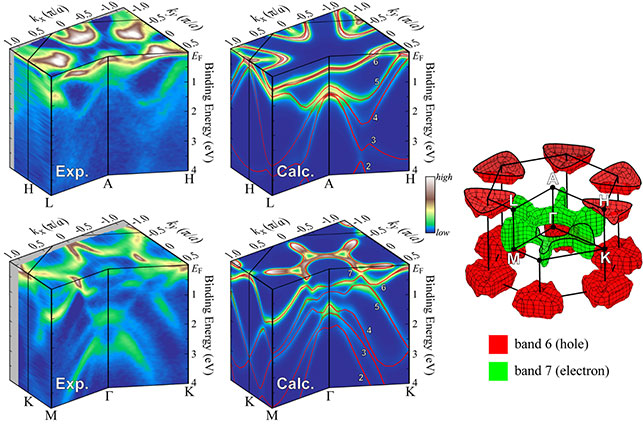
Band structure and Fermi surface observed by soft X-ray ARPES
We have experimentally determined the Fermi surface and band structure of itinerant 5f electron system UB2 by angle-resolved photoemission spectroscopy using soft X-ray synchrotron radiation. By comparing the experimental results with relativistic band-structure calculation, we have found its electronic structure can be described by the calculation S. Fujimori et al., J. Phys. Soc. Jpn. 85, 062001 (2016)
Recent publications
- Direct observation of the magnetic ordering process in the ferromagnetic semiconductor Ga1−xMnxAs via soft x-ray magnetic circular dichroism, Yukiharu Takeda, Shinobu Ohya, Nam Hai Pham, Masaki Kobayashi, Yuji Saitoh, Hiroshi Yamagami, Masaaki Tanaka, and Atsushi Fujimori, J. Appl. Phys. 128, 213902 (2020).
- Spin-polarized Weyl cones and giant anomalous Nernst effect in ferromagnetic Heusler films, Kazuki Sumida, Yuya Sakuraba, Keisuke Masuda, Takashi Kono, Masaaki Kakoki, Kazuki, Goto, Weinan, Zhou, Koji Miyamoto, Yoshio Miura, Taichi Okuda, and Akio Kimura, Commun. Matter. 1, 89 (2020).
- Electronic Structure of UTe2 Studied by Photoelectron Spectroscopy, Shin-ichi Fujimori, Ikuto Kawasaki, Yukiharu Takeda, Hiroshi Yamagami, Ai Nakamura, Yoshiya Homma, and Dai Aoki, J. Phys. Soc. Jpn. 88, 103701 (2019).
- Electronic states of EuCu2Ge2 and EuCu2Si2 studied by soft x-ray photoemission spectroscopy, Ikuto Kawasaki, Shin-ichi Fujimori, Yukiharu Takeda, Hiroshi Yamagami, Wataru Iha, Masato Hedo, Takao Nakama, and Yoshichika Ōnuki, Phys. Rev. B 100, 035111 (2019).
- Manifestation of electron correlation effect in 5f states of uranium compounds revealed by 4d-5f resonant photoelectron spectroscopy, Shin-ichi Fujimori, Masaharu Kobata, Yukiharu Takeda, Tetsuo Okane, Yuji Saitoh, Atsushi Fujimori, Hiroshi Yamagami, Yoshinori Haga, Etsuji Yamamoto, and Yoshichika Ōnuki, Phys. Rev. B 99, 035109 (2019).
- Element-specific observation of the ferromagnetic ordering process in UCoAl via soft x-ray magnetic circular dichroism, Yukiharu Takeda, Yuji Saitoh, Tetsuo Okane, Hiroshi Yamagami, Tatsuma D. Matsuda, Etsuji Yamamoto, Yoshinori Haga, and Yoshichika Ōnuki, Phys Rev B 97,184414 (2018).